


3K vs 18K and What It Means for Your Game
If you have spent any time looking at padel racquets, you will have seen the terms 3K and 18K appearing in product descriptions. Now, you might be wondering why the difference matters for how you play.
This is that explanation.
What the K actually means
The K refers to the number of carbon fibre threads woven together per bundle in the racquet face. 3K carbon has bundles of 3,000 threads. 18K carbon has bundles of 18,000 threads.
The difference in thread count changes everything about how the face behaves on impact – its stiffness, its flexibility, how long the ball stays on the face, and how much energy is returned to the shot.
About 3K carbon
3K carbon has a finer weave. Under impact, it flexes more than higher-K carbons – bending slightly as the ball makes contact before springing back. This flex is what gives 3K racquets their characteristic feel: softer, more forgiving, with what players often describe as a cushioned response.
In practical terms, this means three things.
First, dwell time is longer. The ball stays on the face for a fraction of a second longer – long enough to give the player more feedback, more feel, and more ability to guide the shot rather than simply redirect it. For defensive lobs, drop shots, and precise net play, this makes a significant difference.
Second, the sweet spot tends to be wider and more forgiving. Off-centre hits on a 3K face feel more controllable than the same shot on an 18K face.
Third, 3K carbon absorbs vibration more effectively, which makes it considerably easier on the arm over a long session – an important consideration for players who play frequently or who are managing any elbow or shoulder sensitivity.
The trade-off is raw power. Because the face flexes rather than holds rigid, it cannot generate the same explosive energy return as stiffer carbons. Players who rely on the racquet to amplify their smashes will find 3K faces require more physical input to produce pace.
About 18K carbon
18K carbon has a denser, tighter weave. It does not flex in the same way – instead, it holds rigid on impact, creating a stiff face that transfers energy almost instantaneously back into the ball. The result is a racquet that feels completely different: precise, powerful, and unforgiving in equal measure.
Dwell time is shorter. The ball leaves the face quickly, with less of the softened, guided feel that 3K provides. For players with consistent, technically clean ball-striking, this is an advantage – the face amplifies their power and precision without absorbing any of it. For players with inconsistent technique, that same quality becomes a liability. Off-centre hits on an 18K face are punished rather than absorbed.
The upside is decisive. Smashes hit on an 18K face carry more pace and drop more sharply. Volleys at the net feel crisper. Shots that need to stay low off the glass – the vibora, the bandeja – respond better to the aggressive snap of a stiff face.
18K carbon is also the most demanding face in the Davor range to play with consistently. It is built for players whose technique is already reliable enough to benefit from a face that amplifies rather than absorbs.
The finish matters too – matte vs glossy
Carbon type alone does not determine how a racquet plays. The finish applied over the carbon face significantly changes its behaviour – and within the Davor range, each carbon and finish pairing has been chosen deliberately.
A matte finish allows the underlying carbon to flex to its natural maximum. On a 3K face, this produces the softest, most controlled feel – longer dwell time, greater tactile feedback, and a high-friction surface that bites into the felt of the ball for spin. On an 18K face, a matte finish produces controlled power – reducing the trampoline effect and giving the player complete, predictable control over shot depth and direction.
A glossy finish hardens the outermost layer of the face slightly. On a 3K carbon face, this creates a spring-like response – the ball pops off the face more quickly on fast volleys and defensive blocks, adding pace without sacrificing the underlying softness of the 3K weave.
The combination of carbon type and finish is therefore what defines how a racquet truly performs – not one factor in isolation.
What the Davor PRO Range does with this
The PRO Range by Icíar Montes uses 3K and 18K carbon deliberately across the range, with each racquet pairing the right carbon to the right finish for a specific playing style.
The Icon uses a 3K carbon face with a matte finish – the combination that produces the longest dwell time and the greatest control in the range. It is built for players who place the ball rather than power through it. The round frame amplifies the forgiveness of the 3K face, and the low, even balance – weight sitting closer to the handle – makes it feel light and highly manoeuvrable, particularly when defending deep balls from the back of the court. Because both the round shape and the 3K carbon lean toward flexibility and control, this combination does not generate raw smashing power – players need to provide that themselves through technique.
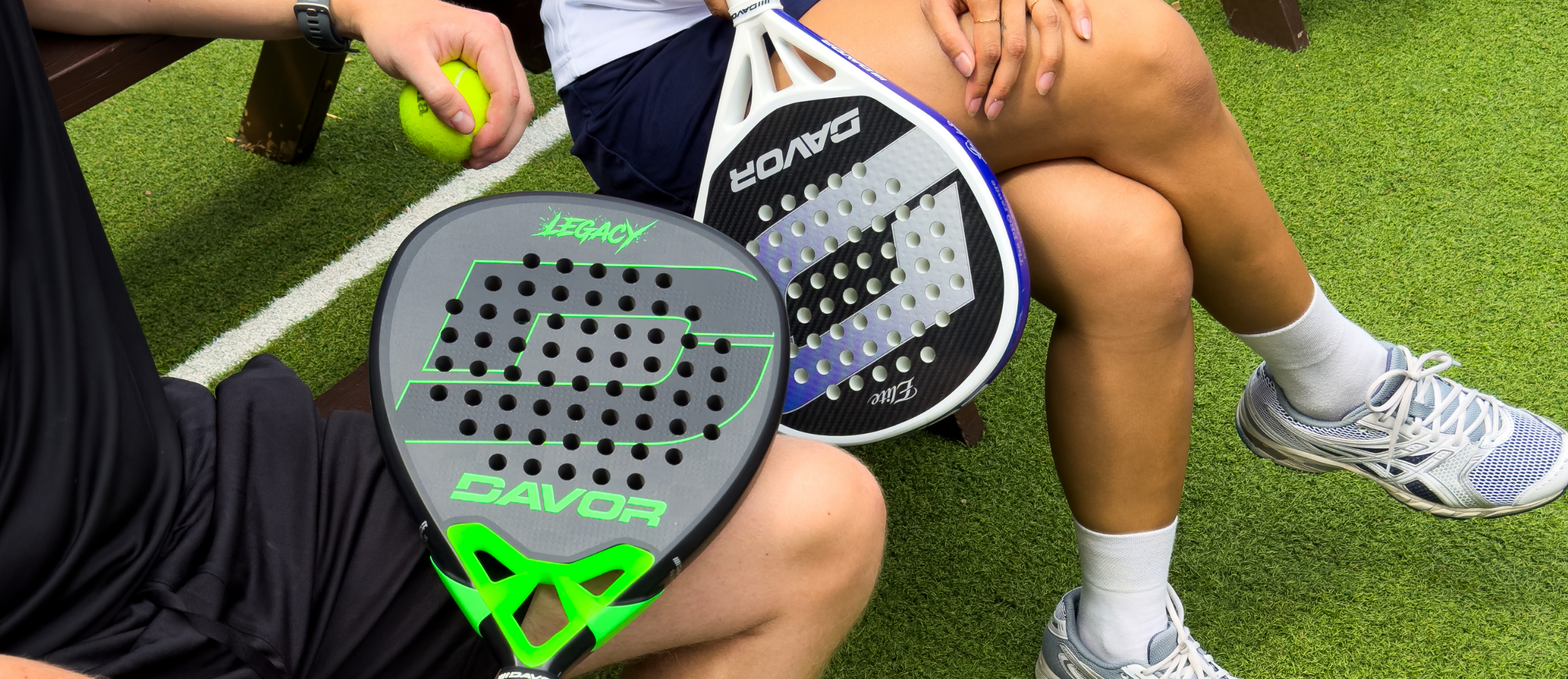
The Elite also uses 3K carbon, but pairs it with a 3D glossy finish and a medium-high balance that makes the racquet feel slightly head-heavy – assisting swing weight and downward momentum on smashes. Where the Icon is about feel and guidance, the Elite is about response – the glossy finish creates a spring-like effect that rewards attacking play. The head-heavy balance and glossy finish combine to maximise leverage for overhead shots while the 3K carbon keeps the sweet spot wide enough to remain forgiving for intermediate-to-advanced players.
The Beacon uses 3K carbon with a 3D glossy finish in a diamond format – but it plays very differently to the Elite despite sharing the same carbon type. Where the Elite balances attack with forgiveness, the Beacon makes a harder trade-off. The glossy lacquer on the Beacon hardens the surface further than a matte finish would, speeding up ball output and protecting the 3D texture over time. Weight is concentrated toward the head, creating a hammer effect that generates immense downward leverage on smashes and aggressive drives. The result is devastating raw power and surgical aerial accuracy – but at the cost of defensive cushioning and forgiveness. It is built for advanced, aggressive left-side players who look to finish points quickly and do not need the racquet to compensate for off-centre contact.
The Legacy is where 18K carbon enters the PRO Range – and it changes the register entirely. A stiff, dense face in a diamond format with a distinctly high, head-heavy balance that provides maximum leverage and inertia when swinging through the ball. The 3D matte finish produces controlled power rather than raw speed – reducing the trampoline effect and giving the player complete, predictable control over exactly how deep each attacking shot lands. The 3D texture bites into the felt for heavy-spinning viboras and bandejas that stay devastatingly low off the glass. There is, however, a meaningful trade-off: the Legacy offers very low natural ball output. When defending deep in corners or retrieving low balls, the racquet will not bounce the ball back – a complete, clean swing technique is required to get the ball over the net. This is the most technically demanding racquet in the range, built for advanced and professional players who generate their own power and demand precision in return.
Outside the PRO Range, the Davor 2026 Collection offers two further racquets – each using 3K carbon, each taking a different approach to it.
The Wizard pairs a diamond frame with 3K carbon and a 3D matte finish. The balance sits top-heavy, concentrating mass right behind overhead shots. The raw matte texture behaves like fine sandpaper across the moulded 3D micro-grains – digging into the felt of the ball and loading viboras, volleys, and cut serves with heavy slice. For players who want the overhead geometry of a diamond frame to finish points, but still want a soft, high-spin feel to construct rallies with measured volleys and deep lobs, the Wizard sits between the two demands without fully committing to either.
The Edge uses a teardrop frame with 3K carbon and a matte finish, and a medium balance that leaves the racquet feeling highly manoeuvrable at the net during fast reflex volleys while retaining enough mass overhead to drive the ball forward. The teardrop shape delivers a centred, elongated sweet spot with genuine forgiveness on off-centre hits, while the 3K matte combination extends dwell time for precise lobs, drop shots, and sliced volleys. It is suited in particular to right-sided, forehand players who build points with precision, heavy spin, and smooth defensive resets – but who still want enough balance to put the ball away when an easy smash presents itself.
So which carbon is right for you?
The honest answer depends less on ability level than on how you win points.
If you win points by placing the ball – by outlasting your opponent, by precision over power, by controlling the rally from the back – 3K carbon with a matte finish will serve your game best. The Icon is the natural starting point: maximum control, maximum manoeuvrability, forgiving on the arm.
If you play aggressively and want a racquet that adds pace to your attacking game while keeping the sweet spot manageable, the Elite takes 3K carbon and pushes it toward its most attack-ready application – with the head-heavy balance and glossy finish doing the work overhead.
If you play on the left side and look to finish points with maximum power and aerial precision, the Beacon takes that attacking intent further still – sacrificing defensive forgiveness for devastating smash power and spin. It is more demanding than the Elite and makes no apology for it.
If you win points by finishing rallies with raw power and technical precision – and your game is consistent enough to handle a face that amplifies every shot rather than absorbs anything – 18K carbon is where your game belongs. The Legacy rewards clean technique with complete, predictable control. Be aware that in defensive situations, it will not do the work for you – every ball needs a full, clean swing to get back over the net.
If you want the aggressive geometry of a diamond frame with the feel of 3K carbon and a top-heavy balance that loads your overhead shots – the Wizard was built for that combination.
If you play all-court, favour the right side, and want a racquet that supports every part of your game with tactical flexibility and a forgiving sweet spot – the Edge is the answer.
The difference between 3K and 18K is not a marketing distinction. It is a genuine change in how a racquet behaves – one that affects every shot, every session, and over time, the shape of your entire game.
The right carbon is the one that matches how you already play – and where you want to go next.
Davor padel racquets are available at Stratford Padel Club and at davorinternational.com